




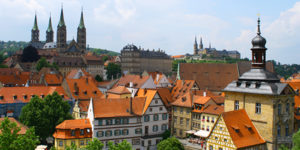
The building itself is a post-classical town house built in 1871, which was rebuilt in 1906 to serve as an official bank house. The company history of Bankhaus Wassermann ends in 1938 with the forced sale under National Socialist rule. Since 2013, three Stolpersteine (cobblestone-size concrete cubes bearing a brass plate, placed outside the houses of the victims of Nazi persecution and inscribed with their names and life dates) in front of the building commemorate Elsa, Edith and Alice Wassermann, who were murdered by the National Socialists in Riga in 1941.

18. April 2018
The building itself is a post-classical town house built in 1871, which was rebuilt in 1906 to serve as an official bank house. The company history […]
18. April 2018
Exceptional are the portraits of Prince Rupprecht and Princess Marie Gabriele, who married in 1900 and thus became the last Bavarian Crown Couple, as well as […]
18. April 2018
Until the 18th century, the monastery served the Bamberg Dominicans as a religious house and for representative purposes. With the secularization the Franciscans also lost their […]
18. April 2018
Until the middle of the 19th century, the area of today’s square was considered as a flood area and therefore contained only comparatively simple houses. Rifle […]
18. April 2018
Apparently the rise of the groundwater had caused the coffins to stand in the water and the deceased did not rot properly as a result. Due […]
18. April 2018
An example of this is the 1717 baroque “Haus zum Saal”, with its striking red stepped gable. Better known by the Bambergers as the Wallenstein House, […]
18. April 2018
The Gate and the origins of Jewish history in Bamberg The Jewish history of Bamberg dates back to the 11th century. Historical sources show that the […]
18. April 2018
The Justice Building (Wilhelmsplatz 1), for example, was completed in 1909 by Max Höfl. Even today, this iconic Renaissance-style square building houses the Higher Regional Court. […]
18. April 2018
The apartment building designed by the architect Gustav Haeberles in 1910 stands with its design for the late youth and reform style. As such, it stands […]

