




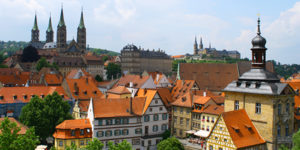
It stands on the territory of the settlement “papinberc”, which Emperor Otto II. gave to the Bavarian Duke Heinrich dem Zänker. The construction of the church began in 1300 and was completed in 1535. Later the windows in the nave and on the choir roof were adapted to the Baroque style.
The Sanctuary of “Our Lady”
The Obere Pfarre is actually a pilgrimage church and bears the name “Our dear Lady”. The pilgrims had to tell the guild master about the craftsmen’s signs as soon as they returned home, so that he knew that the journeyman had actually been to the place in question. Such a craftsman’s sign can also be found in the Obere Pfarre.
On the south side there is a small stair tower leading to the choir organ. Today the unknown builder of the church sits on this staircase, wearing a cowl and raising both arms to the sky. In the meantime both hands have unfortunately been lost.
In these he held a “Düthorn”, which was used to announce the completion of a building. The people saw it quite differently: they interpreted the horn as a drinking horn. So they said that the builder had lost house and courtyard by drinking and to remember, this figure was made. They call the figure “the drunken man”. Until the 1960s, he held the bottle-like-looking rest of the horn to his mouth. But shortly before New Year’s Eve 1961, the bottle was broken off. Today, only the stumps are rising to the sky.
Outer appearance of the Obere Pfarre
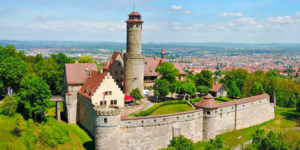
Seen from afar, the Obere Pfarre resembles a ship that comes out of the roofs of the Lower Kaulberg. Another staircase on the north side of the church leads to the Brautpforte (the “Bride Portal”). Here you can see the five wise virgins, the five foolish virgins and the coronation of Mary. The gate is flanked by the two Saints Peter and Paul. On the northern side there is a wooden crucifix, a statue of St. John Nepomuk from the Baroque period, a Gothic Madonna and tombstones. These plaques are witnesses of a time when there was still a cemetery around the church. Two figures can be seen on the tower, the Apostle John Evangelist and the Visitation of Mary.
The interior of the church
Inside the church are countless works of sacral art, such as the 15th century apostles figures, that seem to point the way to the main altar. The main altar itself was donated by Prince Bishop Lothar Franz von Schönborn. It still contains today the miraculous image of a Madonna on the throne. The main altar stands in the center of the church and is surrounded by side altars. The miraculous image of the Madonna is once a year carried in a solemn procession to the Sorrowful Mother of God in the Untere Pfarre (St. Martin Church) on the Grünen Markt.
The tower warden
In the tower there is a two-storey apartment in which the towerman lived until 1920. According to legend, the last towerman must have been a rather unathletic man, who did not plan to leave his tower so often, as it could only be climbed by several steps. Therefore, the towerer used a winch to pull food and drink up to him and let down his human needs. During one of these actions, the barrel came off the winch six metres above the ground and smashed loudly on the church forecourt.
Next to the church the street “Unterer Kaulberg” is located. Here lived at that time above all winegrowers, who are called in Franconia “hackers”.